📌 Key Points
- Last Farmer Jailed! 80-yr-old accused of “peacock murder”! System’s shocking injustice.
- Crop Destroyed by Negligence! Mayandi’s plea for “thousand lives” ignored, fields ruined.
- Profound Truth Revealed: “No farmer? Humanity is the orphan!” A national award-winning film.
- Who is Truly Mad? ‘Development’ crushes farms, questions sanity. A searing societal critique.
‘Kadaiysi Vivasaayi‘, M. Manikandan’s powerful film, has ignited crucial conversations about our farmers’ forgotten struggles. Beyond the screen, however, lies a more harrowing truth. This report unpacks the profound plight of farmers like Mayandi and exposes the silent, desperate fight of our very soil – a battle for survival against relentless urbanization.
Mayandi: The Soul of Soil
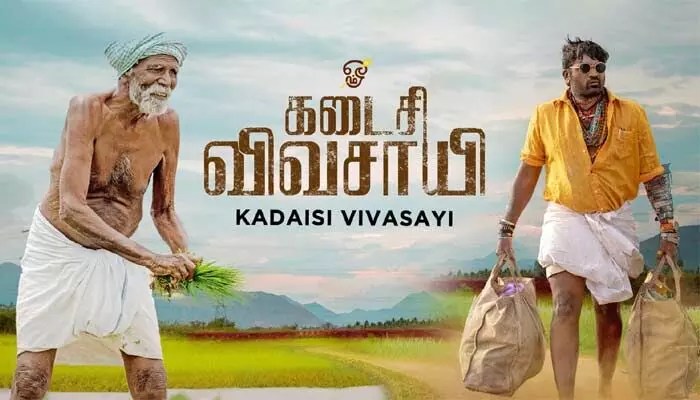
Kadaiysi Vivasaayi: A Mass Struggle for Soil! A Shocking Report on Farmers’ Plight! Directed by M. Manikandan, ‘Kadaiysi Vivasaayi’ is a film set in a rural backdrop that brings forth an emotional story highlighting the life of a farmer and the importance of agriculture. Poised to create a sensation, the film centers on Mayandi, an 80-year-old farmer who, even in contemporary times, has not abandoned his love for agriculture. In a world where the word ‘development’ resonates loudly, we are often swept away by such a fast pace that we don’t have time to question what is being crushed beneath its feet. M. Manikandan’s ‘Kadaiysi Vivasaayi’ transcends mere storytelling; it offers a profound experience. For the fabric of rural Indian life, farming is not merely an occupation; it is a culture, a soul. However, with changing times, agriculture is slowly disappearing, and urbanization is encroaching upon its place. ‘Kadaiysi Vivasaayi’ is a silent film that visualizes these transformations through Mayandi’s life.
Mayandi, an eighty-year-old farmer in a village near Usilampatti, is the last remaining farmer in his village and has never left his land. His is a simple life, a man of few words but profound emotions. He dutifully takes on the responsibility of offering the first grains for the clan temple festival, a task that falls to him because other farmers have sold their lands in the name of development and moved away from agriculture. Against this backdrop, Mayandi sows a new crop, personally carrying out all farming tasks. But an unforeseen incident turns his life upside down when he finds three dead peacocks lying in his field. Considering them vehicles of Lord Murugan, he respectfully buries them. However, acting on information from a villager who misunderstood that Mayandi had killed and buried the peacocks, the police register a case against him, accusing him of ‘killing a national bird’.
Accused, Neglected, Yet Resilient
The film dramatically portrays the consequences of this accusation. With the intention of retaliating for a past incident, the police present the innocent Mayandi as the accused. Even though a witness testifies to the truth in court, Mayandi is forced to remain in jail due to procedural delays. The judge exposes the weaknesses of the police with several questions. During this time, Mayandi expresses his urgent need to return to his farm, stating, “There are a thousand lives in the field that need to be protected, watered, and nurtured, aren’t they?” Moved by his dedication, the judge orders the police personnel to look after the field. Nevertheless, due to systemic negligence, the crop is destroyed. This is not merely the loss of a farmer’s crop; it is a poignant symbol of the decline of our societal values.



Alongside Mayandi’s story, the film presents layered parallel narratives that highlight various societal issues. Vijay Sethupathi plays another important character, Ramayya, who, heartbroken after failing in love with his sister-in-law, becomes insane, believing she is still alive even after her death. He wanders as a vagabond, posing many questions, leading the director to silently raise the question: who truly is mad in this world? Similarly, in the story of farmer Thadikolanthai, who sells his land to buy an elephant, the director presents the neglect that occurs in the name of development. The film further reflects the reality that hybrid seeds, chemical-based agriculture, and high-cost methods are all pushing the small farmer to the brink of ruin. Traditional farming is not just a method; it is humanity’s connection with nature. If that connection is lost, humanity loses its roots – an aspect brilliantly showcased.
When Civilization Forgets Its Roots
From a deeper perspective, the film asserts that from the moment humanity first breathed on this earth, the scent of soil has been in its hands, marking the first breath of civilization. But as time passes, that same soil is slipping from our hands, disappearing into concrete jungles. ‘Kadaiysi Vivasaayi’ gently and silently presents this vanishing story of the soil. Though it appears simple, within that simplicity lies a profound philosophy. For Mayandi, ‘farming is not a profession… it is the very breath of life.’ Mayandi doesn’t speak much, but his hands do; every step he takes on the field is a silent dialogue between humanity and nature. This film has minimal dialogues, yet every silence is a sentence. Even when Mayandi stands in court, his only statement is, “I did my work.” This isn’t just a dialogue; it’s the essence of a life. The film poses a fundamental question: ‘Does the system protect people, or does it crush them?’ A case is filed against Mayandi, a farmer, prompting one to wonder if, in these times, being a farmer has become a crime. Ramayya, a unique character, also brings humor to the film. His often nonsensical words make one ponder: ‘Is what appears ordinary truly ordinary?’ and ‘Is what seems strange actually true?’ Ramayya’s character serves as a mirror to the film’s overarching themes.
“Kadaisi Vivasaayi” translates to “The Last Farmer.” It is not just a film; it embodies life. The film posits, “If there is no farmer, the earth is not an orphan; humanity is.” Recognized with a National Award for Best Tamil Film, “Kadaisi Vivasaayi” vividly portrays the struggles of a farmer’s life and stands as an endeavor to question societal changes.
Looking Ahead
“Kadaisi Vivasaayi” is more than a film; it’s a stark mirror of our impending reality. Its powerful warning – “lose the farmer, orphan humanity” – must echo with urgency. As our soil groans its last, let’s ensure “The Last Farmer” remains a title, not a chilling prophecy for our shared future.


